
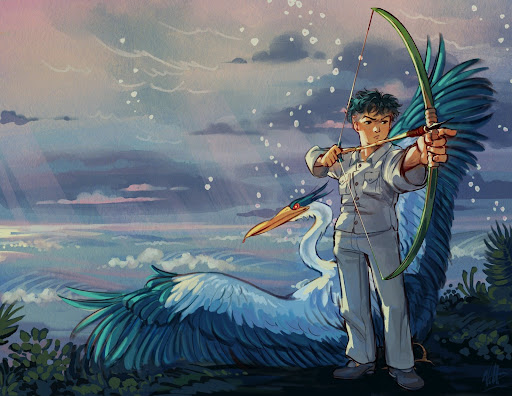
With winter swiftly approaching, 2025’s Ghibli Fest – a yearly celebration that brings some of Studio Ghibli’s most beloved movies back to major theatre chains like Atlas Cinemas and Cinemark from spring to autumn – is coming to an end. To finish off the event, theatres will show the studio’s most recent, and my personal favorite, film “The Boy and the Heron,” which was originally released in 2023, from Nov. 15-19.
While watching the movie at home may seem more convenient, the visuals and soundtrack alone make it worth seeing on the big screen.
Written and directed by Studio Ghibli’s co-founder Hayao Miyazaki, the film follows Mahito, a young Japanese boy forced to move to the countryside during WW2, as he braves the supernatural tower in the woods behind his new home in order to find his mother.
From the opening scenes, “The Boy and the Heron” is a visual marvel. The dark, muted colors of wartime Tokyo are contrasted with blazing shades of amber and orange emanating from fire– one of the film’s most prolific motifs. The audience also gets a glimpse into the main character’s head with a sketchy and, at times, blurry experimental animation style used in the most emotional scenes.
The movie only gets more beautiful as the story moves to a more rural setting, and later to a surreal, fantastical one filled with tranquil green landscapes, sandy beaches and soft skies. I would go as far as to say that “The Boy and the Heron” is Ghibli’s most visually stunning movie, a high bar to cross with films like “Howl’s Moving Castle” and “Ponyo” in the studio’s catalogue.
The English voice cast is absolutely packed with talent, with Florence Pugh, Mark Hamill and Christian Bale, who previously voiced Howl in Studio Ghibli’s “Howl’s Moving Castle,” starring in key roles.
Though, at times, celebrity voice actors can be a detriment to a movie, that is absolutely not the case in this film. Every actor fully embodies the character they’re portraying, keeping viewers immersed in Miyazaki’s world.
On top of this, the sound design and score – composed by Miyazaki’s long-time collaborator and friend, Joe Hisaishi – are masterfully weaved in to heighten the tension in climactic scenes and allow for some sincere and devastating moments throughout the movie. Pieces like “Ask Me Why,” and “The Great Collapse” managed to bring me to tears when I first watched the film.
I also especially appreciate the environmental sound design which, along with little details in the animation – the way a character gets out of a car, for example – makes the otherwise quiet setting come to life.
One of my favorite parts of the movie was the myriad of allusions to famous works of art, from Dante Alighieri’s “Inferno,” to Arnold Böcklin’s “The Isle of the Dead” to the Bible’s “Exodus.” These references not only add to the unsettling atmosphere of the movie, but also ground viewers in an otherwise unfamiliar environment.
The film as a whole is abstract and conceptual, earning it the criticism of being too complex, with reviewer Darren Okafor going as far as to call it “confusing and convoluted.” The criticism, on one hand, is fair. Sometimes, people want a story that’s tied off in a neat little bow, one that requires only one viewing.
I, however, prefer stories like “The Boy and the Heron.” Stories that force you to wrestle a bit more with the material, that leave you thinking about this detail or that for days or even weeks after you watch it.
Additionally, not every part of every story needs to be understood. In fact, sometimes it’s better to leave some questions unanswered, as it can both enhance the atmosphere of the story being told and better reflect the realities of life which are often nebulous and difficult to understand.
“The Boy and the Heron,” much like other Miyazaki films, trusts the audience to view the movie without needing to be handheld through its imagery and symbolism, which is something I deeply appreciate.
The Japanese title for the film “How Do You Live?,” taken from a 1937 novel by Genzaburo Yoshino, is, in my opinion, a better representation of the major themes of the movie and should be kept in mind while watching it. Through the film, Miyazaki asks us this same question, and puts forward what he believes the answer should be.
The movie is an absolute must watch, so go see it in theatres Nov. 15-19, and then again, and again and again.


