![Senior Hermes Pan works on a piece for his AP Drawing portfolio. The College Board has a zero tolerance policy for AI use and plagiarism, notably for their AP art courses. "[Students] have to make sure that [their] work is 90% original," Pan said. "You can have references, but you may not copy [them]."](https://theSHSCourier.com/wp-content/uploads/2025/12/unnamed-2025-12-19T091804.817.jpg)
Art generated by AI text-to-image models dominates social media, largely due to its accessibility and speed at which it can be produced. Artists of many stripes are responding to this new technology bringing change to the art industry and art-related online spaces in various ways.
DALL-E, an AI text-to-image model integrated into ChatGPT and other OpenAI products brought to the public by OpenAI in early 2021, was the first of its kind to be available to the general public and opened the door for similar models to become widespread. Nearly five years since its release, AI text-to-image technology is still getting mixed reviews from creatives.
Senior Shannon Corlett, an artist planning to study art education in college, said that they were taking art classes when AI text-to-image models were first gaining popularity. Corlett was unhappy that people were using these models to generate images at all.
“I could definitely tell what [art] was AI at the time,” Corlett said. “I was really offended by the idea of people not putting in the work that all artists ever have put into making their artwork.”
The ongoing popularity of these AI models is sparking controversy on the ethics of using AI generated images to build up a public platform.
Entire art-based accounts on social media have been “exposed” for using AI, said junior Lillian Litherland, who wants to make money from their illustrations and comics in the future. Whether that be because they used AI text-to-image models in part of their artistic process or uploaded AI generated images as if they were the artist’s own work, several artists on social media have faced criticism for the use of these models.
Ross Tran, a well known social media artist better known as RossDraws online, faced criticism after being accused of and admitting to the use of some AI in his most recent art book project. In a post on his X page, Tran said he only used AI text-to-image models in “the early concept phase” of the book project, but later chose to remove it entirely.
Other online artists like Instagram user Lina and X user Deli Mage have been accused of using AI in their artwork in comments on their posts. Though there is no true way to substantiate these claims at the moment, Litherland said that they are frustrated with the way that people can use AI text-to-image technology to gain large followings online.
“People will buy commissions, and [these accounts] will get money for it,” Litherland said. “All they did was type ‘cool art photo’ into ChatGPT.”
Corporations are beginning to adopt this technology as well. Just this month, for example, Coca-Cola released its second AI generated holiday commercial titled “Holidays Are Coming.” The advertisement has sparked controversy and currently sits at about 8,500 likes and over 126,000 dislikes on Coca-Cola’s official YouTube channel.
Coca-Cola Global Vice President and Head of Generative AI Pratik Thakar told Adweek that despite online criticism, the previous year’s AI advertisement campaign was successful. “You either lead with [AI technology], or you keep crying about it,” Thakar said.
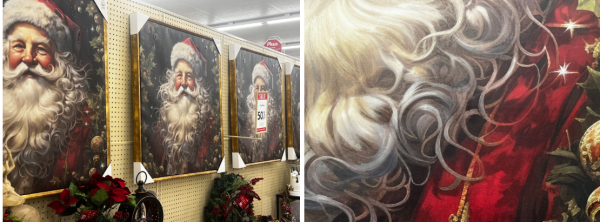
Additionally, companies like Hobby Lobby and Michael’s whose customer base is largely made up of artists are allegedly selling AI generated artwork in their stores.
Litherland said that there is an ongoing “craze” for AI in the business world, and that they have seen all kinds of companies use AI in their products and marketing.
“Everyone wanted AI,” Litherland said. “It was this new thing, and it could do these crazy things and people were like, ‘wow, we’re going to invest money into this,’ and that’s why companies are shoving it into every single product, because [investors] are paying for it.”
“There’s something very human about having [a] certain admiration for something and recreating it in your own way, or creating something that you don’t know how to visualize in your own way,” Corlett said.
In contrast, Fine Arts Department chair and design teacher William Nyerges said he found AI text-to-image models helpful in his workflow.
“I found [AI] kind of neat to use,” Nyerges said. “It’s a nice way of seeing some things before you start in on it.”
Nyerges teaches AP 2-D Art and Design, which he said has much stricter rules on the use of AI text-to-image models. In fact, College Board prohibits the use of AI for student portfolios completely, stating that submitting portfolios in which AI was used will result in a score of 0 or a complete cancellation of the exam.
“If you want to cut something out, you’ve got to cut it out, and you’ve got to show how you do it,” Nyerges said.
AP students have transitioned from using the Adobe program Photoshop to the web-based program Photopea, which has less built-in AI features than Photoshop. Nyerges said this change has also allowed students to work on projects at home, improving the quality of their work.
“[Students] get mad because they can’t do it in two seconds, but it hels keep everything above board,” Nyerges said.
Both Corlett and Litherland said they refuse to use AI text-to-image models in their work, citing concerns for the environment as well as academic and artistic integrity as their reasoning.
“AI is not creating [art] in the same way you are,” Corlett said. “It’s not creating it with intent like you are, with integrity like you are.”