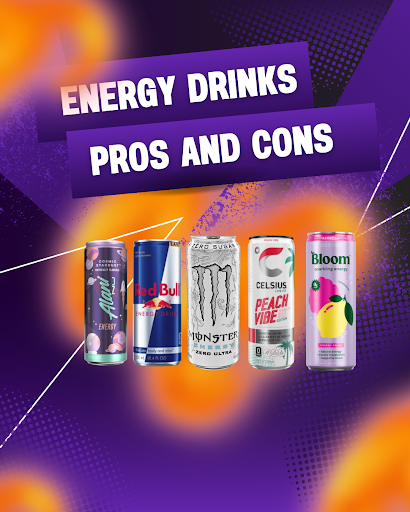
Almost everyone has heard of Red Bull and Monster energy drinks, but recently, new energy drinks have taken over the market. Brands like Bloom, Alani Nu, Celsius, and many more have become well known across social media platforms. The annual sales of energy drinks are $28.18 billion, accounting for nearly 39% of beverage market sales. These drinks are currently trending due to the multiple benefits energy drinks are said to provide– such as enhanced performance, hydration, brain and gut health benefits, and mood and muscle support.
But along with all these benefits, there are many negative side effects that concern consumers as well. Each can contains 6 to 242 mg of caffeine per serving, and sometimes cans can contain more than one serving. Due to this amount of caffeine, energy drinks have led to multiple deaths and adverse reactions being reported. These reactions can include elevated blood pressure, convulsions and heart rhythm abnormalities. Yet even knowing all these possible side effects, people still drink energy drinks daily.
SHS has had a “Coffee Corner” for years, which students can go to if ever in need of a wake-me-up drink. However, beginning in the 2025-2026 school year, the cafeteria has been selling the popular energy drink known as “Bloom” along with a few of their prebiotic sodas. The drinks immediately became popular. You’re guaranteed to see at least one student drinking a “Bloom” every day.
Lynne Hutchinson, MS, RDN, LD, is the Solon Schools registered dietitian and nutritionist, said the school began selling Bloom Energy Drinks for a trial period.
“We’re always open to trying new products that might appeal to students—especially if they’re marketed as having ‘cleaner’ or more natural ingredients,” said Hutchinson. “My goal is to find beverages that are both popular and nutritionally balanced, so I was initially interested in seeing whether this might be a good fit.”
Senior Zoey Xie said energy drinks are very helpful to her during the school year.
“I drink energy drinks because I’m really tired during the school week because I feel like a lot of things build up,” said Xie. “So as I go through the week, I get more tired, and I rely on energy drinks to keep me awake.”
Along with Xie, senior Aaryaa More also finds energy drinks helpful during the school year.
“I occasionally drink energy drinks so that I have enough energy to do my work, whether it be homework or some of my extracurriculars, including Speech and Debate or dance,” said More. “I think, especially senior year, I’ve started to drink more caffeine than I usually do because I have so many things to do and not enough hours in the day, especially with all my college applications and supplementals.”
As for other benefits of the drink, More said she doesn’t experience any besides staying awake.
“In terms of benefits, it just does what caffeine does,” said More.” It gives you a short-lived boost of energy, and sometimes I need that to heighten my performance. Other than that, there aren’t that many benefits.”
While not experiencing many of the benefits reported above, More does experience side effects.
“[I feel] jittery if I don’t eat before I drink them, I think, especially if I drink in a short amount of time, like within the hour, I feel more jittery than usual,” said More. “But since I don’t drink them too much, I don’t face too many side effects.”
Xie said that for most energy drinks, she doesn’t experience any side effects at all.
“I will say certain energy drinks like Celsius will make me really jittery, but [otherwise] really no side effects,” Xie said.
Although both Xie and More drink energy drinks to stay awake, they try to refrain from having them all the time. More says she hasn’t had many since the beginning of the year.
“I think towards the beginning of the year, it was quite hectic, so I would have maybe one or two a week, but nowadays I don’t have them that much,” said More. “I only drink them if I need to stay up for a major event, or I just have a lot of tests one day, or I have a tournament.”
More says she doesn’t think energy drinks are the best for people.
“I would say I don’t recommend drinking energy drinks,” said More. “I think that getting your sleep is much more important than that, but sometimes desperate situations call for desperate measures. I think that if you really need to drink caffeine, stick to coffee. I think coffee is a much better alternative. But if you absolutely need that much energy and you really need to stay up, you need to get a lot done, then once in a while, an energy drink is fine.”
After a few months of selling the Bloom energy drinks at school, Hutchinson said she realized the drinks may not be the best for students.
“Once the drinks were on site, I took a closer look at the nutrition label and compared it to our typical beverage offerings,” said Hutchinson. “That’s when I realized the caffeine level was significantly higher than what I’m comfortable serving to students. Even though it was marketed as a caffeinated option, the actual energy level was too strong, so we started discontinuing them immediately.”
Hutchinson said she chooses what is sold in the cafeterias very carefully.
“Every product we bring in goes through a careful review,” said Hutchinson. “I look for items that have real, natural ingredients, meet USDA Smart Snack standards, and fit within our financial model. Since we operate as a self-supporting program, we have to make sure our choices are both nutritious and sustainable—balancing student health, interest, and the bottom line is always the challenge, but also the goal.”
However, Hutchinson said these drinks didn’t fit these standards.
“[The drinks are] just not something I’m comfortable serving to our students,” said Hutchinson.