
Does anyone think they have the answer?
If you’re a student, it is no surprise to hear this question coming from your teacher after they’ve instructed a lesson. In fact, you may have thought of a possible answer pop up in your head, or were you listening at all?
According to a 2024 survey-based report by The Harris Poll for Discovery Education, nearly half of the teachers say student engagement has fallen. But, why? Studies have shown that classroom participation can be based on the way your teacher sets up the classroom, influencing student motivation, hand raises and answering the teacher’s questions.
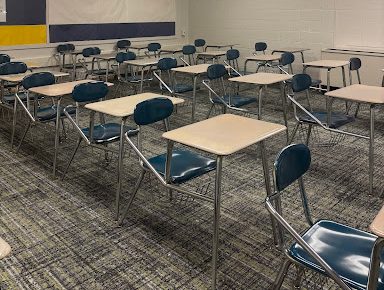
Current college professor at Kent State University’s School of Teaching, Learning and Curriculum Studies and previous high school and middle school teacher Dr. William Bintz agrees that the amount of engagement occurring in a classroom can be influenced by the classroom’s arrangement—specifically, the traditional style.
“[Desks in rows facing one direction] is very traditional,” Bintz said. “Historically, that kind of seating arrangement was not meant for participation but for classroom management.”
Bintz also avoids teaching his students with lectures, a teaching style typically accompanied with the traditional classroom arrangement.
“In my courses, I never use lecture…” Bintz said. “…[It] is not designed to actively engage students.”
Bintz prefers to use a large circle seating arrangement or splitting up his class into small groups, which are layouts geared toward student conversation and engagement.
Bintz also emphasizes that the issue with lecture-based teaching is that it is not designed to actively engage students. However, there are other instructional methods designed to get students participating in class.
One strategy Bintz believes to be useful is designing curriculum geared to the interests of students. Assistant Professor at Case Western Reserve University’s Department of Psychological Sciences’s Clinical Psychology program, R. Elizabeth Capps, who specializes her research in School Mental Health, shares the same sentiment.
“Engagement is enhanced when learning activities are connected to things students are interested in or when class topics are related to things that are relevant for students’ future goals,” Capps said. “For example, for a student who loves basketball, doing a statistics assignment related to March Madness can help the student be engaged.”
Along with this strategy, Capps also believes it is important to embed student comfort in the classroom, which is coordinated with academic engagement.
“Students’ comfort in the classroom is influenced by many different things, including teaching practices, relationships with other students, feelings of belonging in school and availability of and perceptions of support in the school building,” Capps said. “All of those things together influence students’ feelings of psychological safety or students’ feelings that they can speak up and participate in class without negative outcomes.”
According to professors, past teachers and research, it seems that the lecture-based style classroom often discourages students from participating in class. Solon High School senior Kathryn Haaga would say the same.
“[My lecture-based classroom is more] disengaged because people aren’t paying attention as well, especially if they’re sitting at the back of the classroom, and they’re often working on other homework,” Haaga said.
Haaga said lessons are less engaging when the teacher only lectures. She said class could be more engaging when the teacher bases a lesson off of student interest.
So, is this traditional classroom set-up still beneficial with modern day classrooms? Student disengagement is currently the highest it’s been within high schoolers. Student engagement is increasingly important now, as students invested in school will harvest knowledge, opportunity and relationships with their teachers to help develop their growth with learning and skills outside of school.
Is it time to change this norm?
“When it comes to instructional methods, I always try to remember one fundamental principal, ‘nobody learns anything without active engagement in the process,’” Bintz said. “In my courses, I never use lecture for two reasons. One, lecture violates the principle above. Two, my classes are small with 25 students as the maximum amount. Therefore, I don’t need to lecture.”