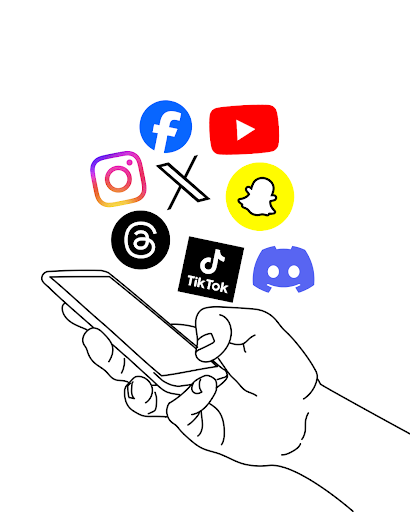
In today’s schools, conversations no longer start in hallways or lunchrooms. For many students, they begin on a screen hours before the first bell rings and continue right after the last bell rings. As social media continues to shape how young people communicate, teachers, parents and students are noticing huge shifts that influence daily interactions.
Emily Donley, an American Sign Language teacher at SHS, has watched these changes develop over time.
“Social media has influenced the way in which students communicate with each other in a myriad of ways,” Donley said. “Languages are living things that continue to grow and change as the technology and people groups in which it is embedded continue to evolve. The way younger students communicate and use language reflects this.”
Social media changes how students talk by making most of their interactions happen through quick messages, emojis or group chats instead of in person. This causes conversations to become faster and more casual, but they now often lack the tone and body language that come with face to face communication.
Students see the same trends happening around them. Senior Eashan Kosaraju notices how online culture bleeds into everyday conversations.
“Many of the trendy memes that come up on social media become points of discussion and even influence the culture that’s prevalent among students,” Kosaraju said.
At Orchard Middle School, a school for grades fifth and sixth, alternative learning environment supervisor Tammi Carson said she sees these habits forming earlier and earlier.
“You can always hear [students] talking about what’s the latest video or trend,” Carson said.
One of the biggest changes teachers notice is how students now use language. Many borrow slang, pick up dialects or shift formality based on what they see online.
“Because students are exposed to a plethora of people across a multitude of backgrounds, be it academic, colloquial, formal, informal, they’re being exposed to these differences [in language], which allows them to learn, share and incorporate these patterns into their own communication,” Donley said.
This exposure also changes how students interact socially. Kosaraju said she sees that the constant time online affects how well students can read each other in person.
“Sometimes, social cues that used to be obvious can be missed because kids spend so much time on social media and forget parts of what real human interaction is like,” Kosaraju said.
When students rely more on screens than face to face conversation, it becomes harder for them to read social cues like facial expressions, tone of voice, eye contact and body language.
Carson has seen fewer students initiating meaningful conversation or checking in on each other.
“Another negative I see is that students don’t just ask you how you are doing or how your day is going,” Carson said. “They’ve gotten away from caring about each other and focus more on social media trends or how many likes they have on a Tiktok video they posted.”
Teachers have also noticed shifts in how students behave in different social settings.
“There is less of a distinction across social hierarchies,” Donley said.
The usual groups within school social life, like popular kids, athletes, quieter students or academic students aren’t as clearly separated anymore. So much interaction happens online which causes students to mix and communicate more.
Also, social media often affects students’ confidence. For some, a lack of likes on posts makes them more withdrawn. For others, online praise makes them louder and more energetic in class.
“The other side to this is that some kids are more vocal because they received a lot of likes or good comments on something they posted, and they feel good about themselves,” Carson said.
Though concerns are widespread, students also recognize that social media isn’t entirely negative.
“I think social media can help create bonds between people and a positive culture in some cases,” Kosaraju said. “It can also be used to spread movements and voice opinions.”
How social media exposure to different cultures and identities impacts students is a matter of ongoing discussion.
“I think the sharing of culture and linguistic diversity can be a powerful and positive aspect about social media,” Donley said.
While platforms continue to grow, adults are still working to help students find a balance.
“Just because it is so common, it still needs to be regulated by parents,” Carson said.
Teachers, students and families agree that social media isn’t going away anytime soon. The challenge now is helping students build strong, face to face communication skills while navigating a digital world that increasingly shapes how they learn, talk and connect.
“Students often think that social media can be a source of relaxation. In reality, it’s also a significant cause of anxiety among students,” Kosaraju said.