
There is no doubt about it: college is an opportunity unlike any other. It’s the opportunity to grow, develop and expand knowledge in a specific field while gaining personal experience— harnessing skills and traits for the future. It’s a structured ideal in American culture to attend a four-year college post high school, and 59% of parents to high school-leveled students say the same.
But, there is also no doubt that college is expensive. The average total cost of college–meaning, the cost of tuition and room and board–in the United States ranges from $30,000-$63,000 per year, depending on whether the school is public or private. In the 2024-2025 school year, 50% of families relied on scholarships and grants or borrowed funds, while 48% of families supported the price of their student’s college education by paying out of pocket.
However, the cost of college wasn’t always like this. The sticker price of an undergraduate degree has gone up because of increasing administration and campus amenities, as well as declining state funding (for public institutions). These factors have caused college prices to essentially double over the past three decades.
Modern day prices leave 61% of graduates facing student debt. As of 2025, the total average student loan debt is $42,673. This price is not just a number seen on a loan servicer’s website— it’s a number tolling the mental health of Americans.
First-year college undergraduate at Miami University Jessica Beres said she was stressed when choosing a college as she was finishing high school, especially because of its cost.
“[Choosing a college] came down to cost and how much my parents had saved up and then how much I would have to pay if I actually went to a bigger school that would make me go into debt,” Beres said. “I just really had to think about all of the things that go into picking a college…I think a lot of people don’t realize how much it actually takes. It was a very stressful process over my junior year picking colleges to apply to and senior year actually narrowing it down.”
High school seniors stress about the finances of affording college, and this worry may last for years after completion of a bachelor’s degree as 73% of Americans associate the debt accumulated from attending university with their stress levels.
Solon High School senior Andrea Sanchez Camacho said she’s begun to worry about this debt.
“The finances of college are very stressful to me because the idea of going into debt is scary,” Sanchez Camacho said. “I’m not sure what I would do if I couldn’t get out of it.”
Additionally, a factor not always considered by incoming college undergraduates is the actual cost of living on campus. The prices of hygiene items, clothing, groceries, etc. can add up.
“There’s just so many things that you have to pay for that you really don’t think about when you’re just signing the acceptance letter to your college,” Beres said. “You want to go out to dinner with your friends or you want to buy extra snacks and you need to buy groceries. Maybe you need extra toothbrushes and you need shampoo, conditioner and laundry detergent. You need to pay for laundry there and that’s not in the tuition.”
Beres explained just how stressful these unaccounted for costs can truly be.
“That really is stressful for so many college students because, yes, some of those things aren’t needed, but also a lot of those things you just need to live a good hygienic life and be happy,” she said. “You can’t do that sometimes when you’re paying thousands of dollars for college, and I have to save up for the next semester. You also just need to clean your laundry, and you might not have enough money right there. It’s very concerning and it’s just crazy…that’s something that’s very stressful for me is the money.”
60% of students at private universities and 36% at public universities live on campus as first-year students, meaning that they will have to face the expenses of basic necessities that are not always given a glance when discussing college, as Beres mentioned.
Solon High School senior Kathryn Haaga believes the price of these necessities may affect her life as she begins college.
“I might need to get another job on the side, and it’s just in order [to] earn enough money for food and housing and gas and stuff,” Haaga said.
Although the financial aspect may be a serious issue for American students, it’s important to acknowledge the bonus college provides: potential for higher earnings in the future, specific to the major. Majors such as engineering, computer science, nursing, accounting and biochemistry take the place as the top five majors with the best Return on Investment (ROI), respectively, where graduates from these fields can see a $100,000 based salary almost as soon as they enter their industry.
Current Solon High School senior Ashwin Ramachandran will be a first-year student at Cornell University studying data science this fall. Ramachandran said he acknowledges the high costs of his school, but he looks at it less as a financial burden, but more as a return of value he can get from his education.
“I see Cornell as a very strong investment, mainly because it’s really about the network and the hands-on things that you get to do there,” he said. “Being a student [and] being able to join project teams…or even getting into research early on gives you a huge head start. You’re basically paying for a community of people who are all super smart and headed to the top of the industry that they choose. Looking at the starting salaries for data science grads at Cornell, it’s [high enough] that the tuition feels more like a good investment than just an expense.”
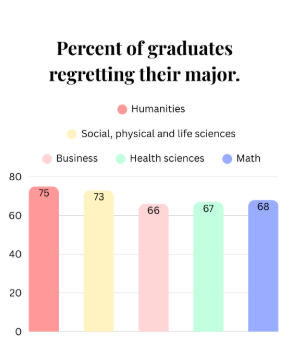
Despite the high expected salaries for majors like Ramachandran’s, it’s not always guaranteed to assist in paying off debt–not for everyone, at least. About 66% to 68% of business, health sciences and math graduates regret their majors, as well as 73% to 75% of humanities, social, physical and life science graduates. As of 2024, only half of college graduates were satisfied with their starting salaries.
The increasingly high costs of college today in America places an unfair amount of stress and pressure on young adults, which is too normalized in a country where the price of living has been increasing over time.
More colleges should institute policies to alleviate the costs of college, in turn, reducing the risk of mental health issues among college graduates. Some institutions have acknowledged this and begun working to cut the price for families. For example, Emory University will eliminate tuition costs for families making under $200,000 and The Ohio State University’s Regional Campus Commitment allows low to middle-income students to earn their degree tuition-free, starting on one of their regional campuses.
These are steps in the right direction, and it would bring a sense of peace to see more colleges getting involved in similar initiatives given the current climate of the rising sticker prices for a four-year degree.


